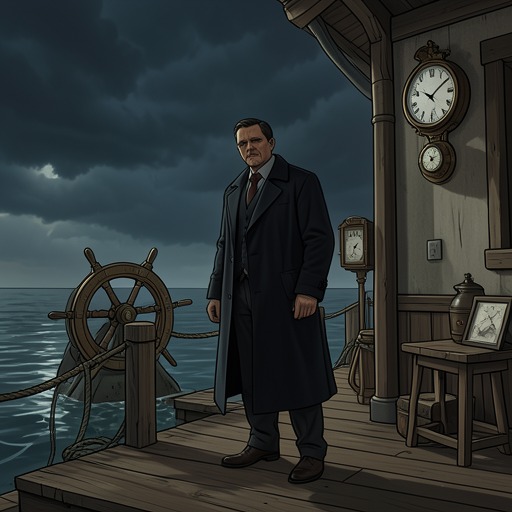
Fogg buys and burns the Henrietta for fuel
Around the World in Eighty DaysPhileas Fogg buys the Henrietta and burns its wooden fittings for fuel when the vessel’s coal supply can no longer sustain the journey toward London. The episode turns the ship itself into the means of its continued passage: Fogg pays Andrew Speedy for the vessel, then dismantles it piece by piece to keep steam up. By the time the Henrietta reaches the Irish coast, its cabins, spars, fittings, and much of its deck have become fuel, while Fogg has only twenty-four hours left to reach London.
The coal crisis and Fogg’s decision
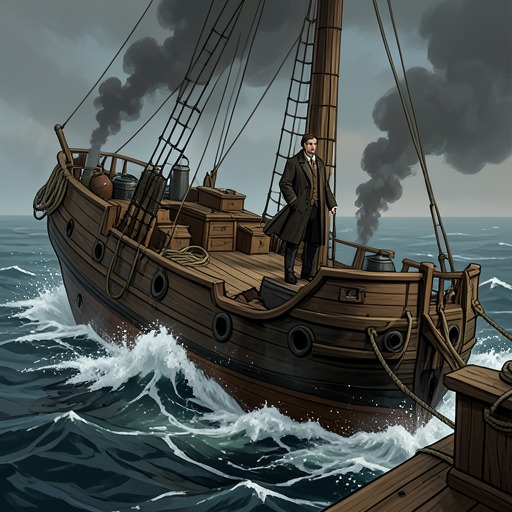
The decision follows a stark countdown. On the evening before the coal is expected to give out, Fogg summons the engineer and orders him to feed all the fires until the supply is exhausted. Smoke pours from the funnel as the Henrietta proceeds at full steam. The engineer’s prediction is borne out: on the 18th, he reports that the coal will run out during the day. Fogg refuses to let the fires die down and orders the crew to keep them burning to the last, even filling the valves. His response treats the remaining fuel not as something to conserve for an uncertain future, but as the resource to spend completely on forward motion.
The next step is to bring Andrew Speedy to him. Fogg first has Passepartout fetch the captain; to Passepartout, who expects Speedy to react furiously, the summons resembles an order to unleash a tiger. The scene’s tension comes from the mismatch between the captain’s likely anger and Fogg’s practical purpose. Fogg asks to buy the ship. Speedy refuses, and Fogg answers that otherwise he will have to burn it. The threat makes explicit the choice created by the emptying coal supply: either the vessel becomes Fogg’s property, or its materials must still be consumed to keep it moving.
The purchase and reversal
Speedy’s resistance is bound up with the value he places on the Henrietta. He protests that it is a vessel worth fifty thousand dollars. Fogg offers sixty thousand in bank-bills, and the captain’s anger gives way almost at once. The captain forgets his imprisonment and his grudges against his passenger; the Henrietta, already twenty years old, now looks to him like a bargain. The threatened destruction of his ship does not disappear so much as change its meaning: Speedy is no longer being asked to accept its loss without compensation.
The transaction also changes who can decide what happens to the vessel. Speedy remarks that he will still have the iron hull, and Fogg confirms that the Henrietta now belongs to him, from keel to masthead, as far as its wood is concerned. That qualification matters. Fogg has not acquired an abstract means of transport that can be kept intact; he has acquired the wooden parts that can be fed to the boilers. The captain’s claim to the hull marks what remains outside the sacrifice, while Fogg’s ownership makes the sacrifice possible without turning the plan into an act of simple destruction without consent.
Dismantling the Henrietta
Fogg orders the interior seats, bunks, and frames pulled down and burned. Dry wood is needed to maintain adequate steam pressure, so the conversion is deliberate and functional: parts built for passengers and the ship’s ordinary use become fuel. On the first day, the poop, cabins, bunks, and spare deck are sacrificed. The following day, December 19, the crew burns the masts, rafts, and spars. Passepartout joins the work, hewing, cutting, and sawing with all his might as the dismantling gathers force.
The destruction continues in stages rather than in a single dramatic blaze. On December 20, the railings, fittings, most of the deck, and the topsides disappear. The result is a flat hulk, the stripped remainder of a vessel whose useful wooden structure has been expended to maintain its steam. The sequence gives Fogg’s order a material consequence: the Henrietta’s progress is purchased not only with money but with the ship’s own fabric. The crew’s labor and Passepartout’s strenuous participation make that transformation an ongoing task, measured in the successive removal and burning of specific parts.
The Irish coast and the remaining deadline
On the day the Henrietta is reduced to a flat hulk, the passengers sight the Irish coast and Fastnet Light. By ten that evening, they are passing Queenstown. The ship has carried Fogg to a crucial point, but the fuel crisis has not yielded a comfortable margin: he has only twenty-four hours left to get to London, and that time is needed to reach Liverpool at full steam. The vessel’s own remaining power is nearly spent as well.
Speedy, now interested in Fogg’s project rather than resisting it, tells him that everything is against him and points out that they are only opposite Queenstown. Fogg asks whether the distant lights are Queenstown. The contrast closes the episode: the ship’s destruction has brought the party within sight of Ireland, but sight of the coast is not the same as arrival in London. The purchase and burning of the Henrietta solve the immediate problem of fuel by converting the ship into fuel, yet leave Fogg’s larger race against time unresolved.